
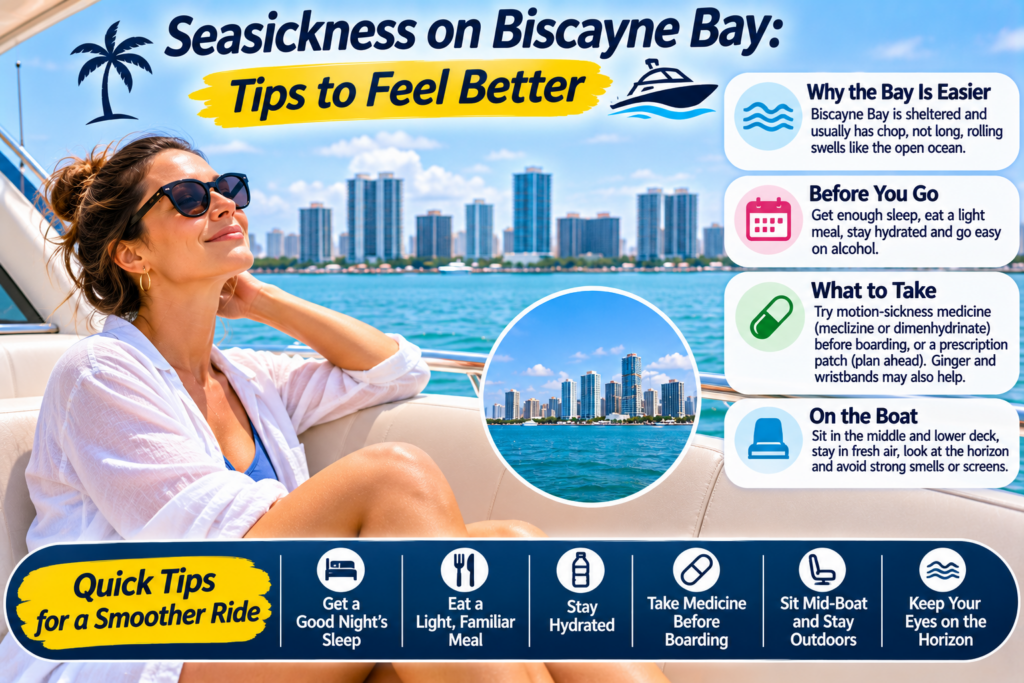
Will you get seasick out on Biscayne Bay? Most people don’t, and the ones who do can usually head it off. What you do before you step aboard matters more than anything you try once the boat is moving.
Why the bay is easier than the open ocean
Biscayne Bay sits behind the barrier islands, so the long, rolling Atlantic swell that makes people ill offshore mostly doesn’t reach it. The bay is also shallow. A rolling swell is slow and heavy, and the bay doesn’t produce one. What you get instead is chop.
Chop comes from wind. When the breeze fills in from the east, the water between the skyline and Key Biscayne gets short and choppy, with a quick slap against the hull. Some people find that more irritating than a gentle roll.
The second source is traffic. Boats of every size cross the bay, and their wakes arrive from odd angles and cross each other. Near the shipping channel and the cuts to the ocean, the water can feel livelier than it does over the flats farther south, where it is calm.
Knowing that tells you what to plan around. You aren’t preparing for a swell. You’re preparing for wind chop and wakes, and you can manage both.
Before you get on the boat
Sleep matters more than people expect. A tired body is a more sensitive one, so a late night before an early outing is a bad trade.
Eat something real beforehand. An empty stomach is not safer than a full one. Go for plain, familiar food such as toast, eggs, rice or fruit. Skip anything greasy, very spicy or heavy, and go easy on alcohol the night before, because a hangover and motion are a rough combination.
Drink water. Dehydration makes nausea start sooner and last longer, and Florida sun adds to it.
What to take, and when
The timing rule is simple: medication for motion sickness works by prevention. Once you feel sick, it is much harder to catch up, and swallowed tablets may not stay down. Over-the-counter antihistamines such as meclizine or dimenhydrinate are the common choices. Take them before you leave, following the label, and expect some drowsiness. That is a reasonable price for a calm afternoon, but it is worth knowing if you plan to drive afterward.
A prescription patch worn behind the ear is another option. It has to go on well ahead of time, often the night before, so it needs a conversation with a doctor in advance. It is not something you can pick up at the dock. Ginger, in chews, capsules or tea, is popular and harmless for most people. Evidence that it works is mixed, so treat it as a gentle extra, not your only plan. Pressure wristbands have the same mixed record. Some people swear by them, and they cost little to try.
If you are pregnant, taking other medication, or buying for a child, ask a pharmacist or doctor which option is right. This is the one place not to guess.
Once you are aboard
Where you sit changes how you feel. The middle of the boat, and low down, moves least. The bow and the very back exaggerate every bump. If the boat has an open deck, stay out in the air instead of going below. Fresh air and a clear view of the horizon help more than any gadget.
Look at something far away and steady, like the skyline, a distant island or the horizon line. Your inner ear feels motion your eyes don’t see, and that mismatch is what makes you sick. Giving your eyes a fixed point resolves it. Reading, scrolling a phone or staring down into a cooler does the opposite.
Keep sipping water, and nibble something dry like crackers if your stomach feels uncertain. Stay out of strong smells, including fuel, sunscreen fumes and cigarette smoke from another boat nearby.
Conclusion
Tell whoever is running your trip that someone in your group gets queasy. That one sentence gives the captain a reason to read the water differently, choose a heading with you in mind, and stop sooner if anyone starts to struggle. It costs nothing, and it is the most useful thing you can do after taking your medicine.
Frequently Asked Questions
Can I get seasick even if I never have on a boat before?
Yes. Sleep, hydration, heat and what you ate all shift your tolerance from day to day. Plan as if it could happen, especially if you tend to get carsick.
Should I eat before going out or stay empty?
Eat something light and plain. An empty stomach tends to make nausea worse, not better.
Is it too late to take medicine once I feel sick?
It is much less effective by then. Medicine works best when it is already in your system before the boat moves.
Does the bay get rough enough to ruin the day?
It can on windy days, usually from short chop instead of a swell. Check the wind forecast, ask the captain what conditions look like, and choose a calmer part of the day when you can.
What if one person in my group is sensitive and the others aren't?
Tell the captain when you book or when you arrive. Small changes in speed, heading and where the boat stops can make a big difference for one passenger without spoiling things for everyone else.
Are children more prone to it?
Children under about adolescence tend to be more sensitive, and medicine decisions for them should come from a pediatrician or pharmacist. Keeping them on deck, in the air and watching the horizon helps a lot.