
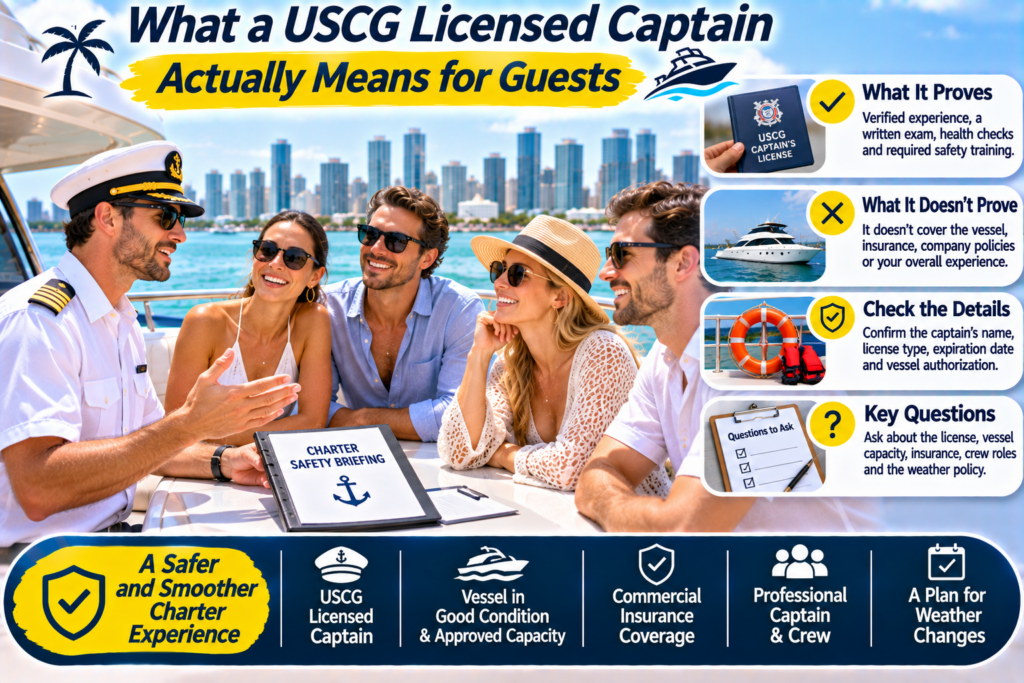
You saw “USCG licensed captain” on a charter listing and want to know whether it protects you or just sounds reassuring. It protects you, within limits. The license tells you something specific about the person at the helm. It tells you nothing about the boat, the insurance, or how the day will feel. Here is what each part means and how to check it.
What the license proves about the captain
A captain holding a United States Coast Guard credential has been through a government process, not a company’s own training. In plain terms, that process covers four things.
Documented time on the water. The Coast Guard requires applicants to prove their sea time on paper. A captain can’t get the credential by saying they have experience.
A written exam. Applicants are tested on navigation rules, chart work, weather, emergency procedures and how to handle a vessel carrying passengers. These are the situations that matter when a group is aboard and conditions change.
Health and background checks. A medical evaluation, a drug test and a background review are part of the package. The agency wants to know the person in charge of your group is fit to be.
Safety training. First aid and CPR are required, so someone aboard knows what to do before help arrives.
The credential also has to be renewed. A captain who lets it lapse is no longer licensed, which is why current paperwork matters more than a framed certificate on a wall.
What the license does not prove
A license belongs to a person. It says nothing about the following.
The vessel. A qualified captain can still run a boat that is poorly maintained, missing required safety gear, or not approved to carry the number of people aboard. The credential and the boat are checked separately.
The insurance. Coverage for a commercial charter is a policy held by the company. A captain can be licensed while the business behind them is underinsured.
The company. A licensed captain can work for an operator with weak habits around cancellations, deposits or crew conduct.
Your experience. A great license holder can still be a poor host. Credentials show competence, not hospitality.
So the license is the right first question, but it should never be the last one.
How to check the credential yourself
You do not have to take anyone’s word for it. The Coast Guard issues credentials to named individuals, so ask for the captain’s full legal name exactly as it is printed, and compare it with a photo ID on the dock.
Look at the expiration date, not only at whether a credential exists. Then read what it authorizes. A credential lists the type of vessel and the waters it covers, and that should match the trip you booked.
A reasonable operator will send a clear photo of it before the day and will not mind being asked twice. If you get a story instead of a document, treat that as your answer.
Where the captain’s license fits in the full picture
Think of safety on a charter as layers. The captain’s credential is one. The others are the vessel’s condition and approved capacity, the commercial insurance, the safety gear aboard, and the crew supporting the captain. A responsible operator can explain every layer without hesitation. This operator lays out its approach on a dedicated page about safety, licensing and insurance, and it introduces the people you will meet on the dock on a page about the captain and crew.
If you are comparing operators, read the same pages for each one. The ones that go quiet or stay vague when you ask about specifics are telling you something.
What a good captain does before leaving the dock
The license shows up in the small habits long before the boat moves. A captain who takes the role seriously will check the weather and the vessel, test the radio, and gather everyone for a safety briefing.
That briefing should cover where the life jackets are and how to put one on, what to do if someone goes overboard, where to sit and stand while underway, and the rules for swimming. Guests with children should hear which jackets fit them. A group of up to thirteen is small enough to brief together, so there is no excuse for skipping it.
Signs worth walking away from
A few things should slow you down before you pay a deposit.
- The operator will not name the captain or show a credential.
- Safety questions are answered with adjectives instead of specifics.
- Nobody can say who decides when the weather is too rough.
- Insurance is described as covered without anyone saying who holds the policy.
Any one of these is fixable with a straight answer. All four together mean you should book elsewhere.
Questions worth asking before you pay a deposit
You are allowed to ask, and a good operator expects it. These questions are fair on any charter.
- Is the captain’s Coast Guard credential current, and can I see it?
- Is the credential the right type for this vessel and the size of my group?
- Is the boat approved to carry my full group?
- Does the company carry commercial insurance for passengers?
- Who else is aboard besides the captain, and what are their roles?
- What happens if the captain judges the weather unsafe on the day?
The answer to the last one reveals the most. A captain who will cancel for safety, and a company that backs that call, is exactly who you want in charge. For a group that wants the whole boat to itself, a private yacht charter keeps these conversations simple, because there is one crew, one boat and one set of answers.
How to read the wording on a listing
Charter listings use the word “licensed” loosely. Three phrases look similar and mean different things.
“Licensed captain” refers to the individual and should be a Coast Guard credential.
“Licensed and insured company” refers to the business. It is good to see, but it says nothing about who is steering.
“Fully permitted” is a general claim. Ask which permits and who issued them.
When the wording is specific, you can verify it. When it is general, you can only trust it. Ask for the specific version.
Conclusion
A Coast Guard license is the best single signal that the person running your day has met a real standard, and the easiest one to confirm. Ask to see it, ask what else stands behind it, and choose the operator who answers without a pause. If you would rather talk it through with a person, call (786) 839-6753 or stop by 1508 Bay Rd, Miami Beach, FL 33139, and put your questions to the crew directly.
Frequently Asked Questions
Is a USCG licensed captain the same as a certified captain?
In everyday charter talk, people use the words interchangeably, but the Coast Guard credential is the one that counts. Ask for the credential itself rather than a course certificate from a private school.
Does the captain have to be on the boat the entire time?
Yes. On a crewed charter the captain is in command from the dock to the dock. Guests do not drive the vessel.
Can I ask to see the captain's credential?
Yes. Reputable operators are glad to confirm it before you book, and many will show it on request.
Does a licensed captain mean the weather will not cancel my trip?
No, and it should not. A licensed captain is more likely to call off a trip when conditions are unsafe, because the credential carries real responsibility. Read the operator’s weather and cancellation policy so you know how a safety call is handled.
Does the license cover swimming and water toys?
The credential covers operating the vessel. Swimming and water activities depend on the conditions, the crew’s briefing and the equipment aboard, so ask how the crew manages them.