
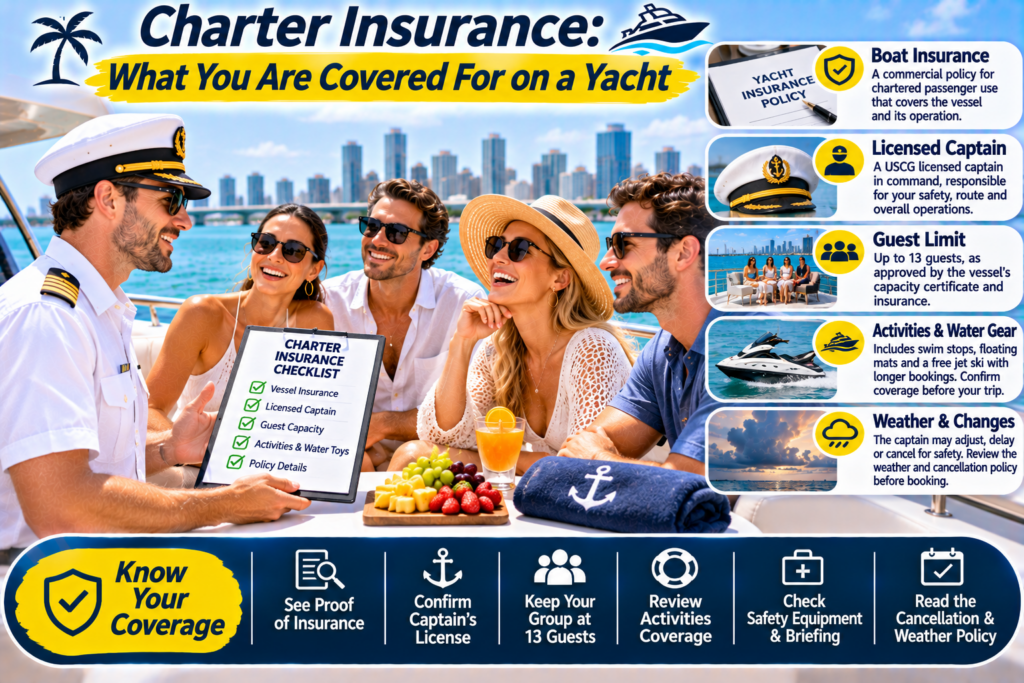
If something goes wrong on the water during your charter, who is responsible, and what is actually protecting your group? Most people asking about charter insurance want that one thing settled before they commit to a date. The honest answer has layers: the boat’s insurance, the licensed captain in command, the capacity limit, and your own cover. Each does a different job, and knowing which does what stops you assuming something is covered when it is not.
What the boat’s insurance is for
The yacht carries insurance written for chartered passenger use, and that wording matters. A boat used privately by its owner and a boat rented out to paying groups are not insured in quite the same way, and a charter operator needs the second kind. In practice this is the policy that stands behind the running of the boat while your group is aboard, and it belongs to the operator, not to you.
The fine print, meaning the insurer, the limits, the excess and the exclusions, sits in the policy document itself, so ask to see proof rather than guessing. If you are booking and want written evidence of cover for your date, ask the team ahead of the day. Do not leave it until you are standing on the dock with your guests behind you, because nobody can produce a policy document from thin air at the last minute, and a charter that cannot show its paperwork is a charter worth questioning.
Who needs proof, and when
Some people need paperwork rather than reassurance. An employer, a venue or a planner may want written evidence of cover before they approve the booking. for a team outing is the usual example, but anyone organising a private celebration on behalf of other people can run into the same request.
If that is you, say so in your first message. Asking early turns it into a routine document request. Asking on the morning of the charter turns it into a problem for everyone.
Why the captain’s licence is part of the answer
Command of the boat sits with a captain licensed by the United States Coast Guard. The captain decides the route, the speed, where to anchor and how to dock, and the crew works to that direction from the moment you leave the dock until the boat is tied up again.
That is a safety point, but it is also a paperwork point. Who is at the wheel, and whether they are qualified to be there, is a central part of how a passenger charter is allowed to operate and be insured. For you, the practical side is simple. Follow the captain’s instructions, keep the walkways free of bags and drinks, and stay away from the bow and the rails whenever the boat is under way. A great deal of avoidable trouble on any charter starts with a guest doing exactly what the captain has just asked them not to do.
Thirteen guests, and why the headcount does not bend
The boat has a capacity certificate, and for your group the maximum is thirteen guests. That limit is the same on every date. Nobody can be added as a favour, whether that is a latecomer, a partner or a surprise guest, because the captain has no authority to grant one.
There is an insurance reason behind the rule as well as a safety one. A boat carrying more people than its certificate allows is operating outside what it was approved to do, and that is exactly the situation in which questions about cover become uncomfortable. Plan the guest list around thirteen from the first invitation, and send the final headcount to the team before your date so nothing is left to be settled at boarding.
Your own cover is still your job
Treat the operator’s policy as protection for the boat and its operation. It is not automatically a replacement for your own travel, health or personal property cover. Whether it reaches your belongings, your medical costs or a phone that ends up in the water is a question to put to the team in writing, not something to assume on the day.
It is also worth checking what your own policies say. Travel insurance, a card with built-in protections or an events policy may each treat a day on a boat differently, and it is far better to find that out at the kitchen table than from the deck.
Before you book, ask the team these questions and keep the answers:
- Can I see proof of cover for my date, and what does it name?
- Does the cover include activities in the water, or only the cruise itself?
- Are my group’s personal belongings covered, and if not, what should we leave at home?
- Is there anything guests must read, sign or acknowledge before boarding?
- What happens if a guest damages something on the boat?
Swim stops, water toys and the jet ski
The parts of a charter people remember most are often the parts where cover questions matter most: anchoring up for a swim, floating on mats, riding the jet ski that comes with longer bookings. Ask whether activities in the water are insured in the same way as the cruise, and confirm exactly which water gear comes with your booking before you promise anything to your group.
where much of the day is spent in the water rather than on deck. A short question beforehand is quick to ask, and the answer lets you brief your guests properly, including anyone who is a weak swimmer or travelling with children.
Safety equipment and the briefing
The boat carries its required safety gear, which includes a first aid kit, fire extinguishers, life jackets and throwable flotation, and the crew checks it before guests arrive. Once everyone is aboard, the crew points out where each item is kept and how to get about the deck safely while the boat is under way, including where to sit when the water is choppy.
Give that briefing your attention. It is short, it is easy to talk over when the group is excited, and it is the part of the day that has nothing to do with insurance and everything to do with never needing it.
When the weather turns
If conditions change, the captain decides whether to go out, alter the route or come back early. That decision belongs to the captain alone, and pushing for a different call is a poor way to begin a day you want to enjoy. How a weather decision affects your booking is set out in the weather and cancellation policy, which is worth reading before you pay for anything.
Frequently Asked Questions
Is the yacht insured?
Yes. The cover is written for chartered passengers rather than for the owner’s private use. The details of the policy sit in the policy document, so ask for proof of cover before your date rather than relying on a general statement.
Can I get proof of cover for an employer, venue or planner?
Yes, if you ask ahead of the charter day. Send your date and the name of whoever needs it, and the team will tell you what can be provided. Call (786) 839-6753 to start.
Does the insurance cover my belongings or my medical costs?
Do not assume it does. Ask the team in writing, and check what your own travel, health or property cover says about a day on a boat.
Are swim stops and the jet ski covered?
Ask the same way, and confirm which water gear is included with your booking. Put the answer in writing so everyone in your group knows where they stand.
Can I bring extra people on the day?
No. The limit is thirteen guests on every date, and it comes from the capacity certificate rather than from the crew’s preference. Confirm your final headcount before you travel to the boat.
Who is in charge if something goes wrong?
The licensed captain is in command, with the crew working under that direction. Guests are expected to follow the instructions of both, particularly around the bow, the rails and any change of plan.
Do I need my own insurance as well?
That depends on what you already hold. Many people have travel or health cover that applies without any extra step, so check what yours includes for activities on a boat before you decide.